
Corporate Trainer in India
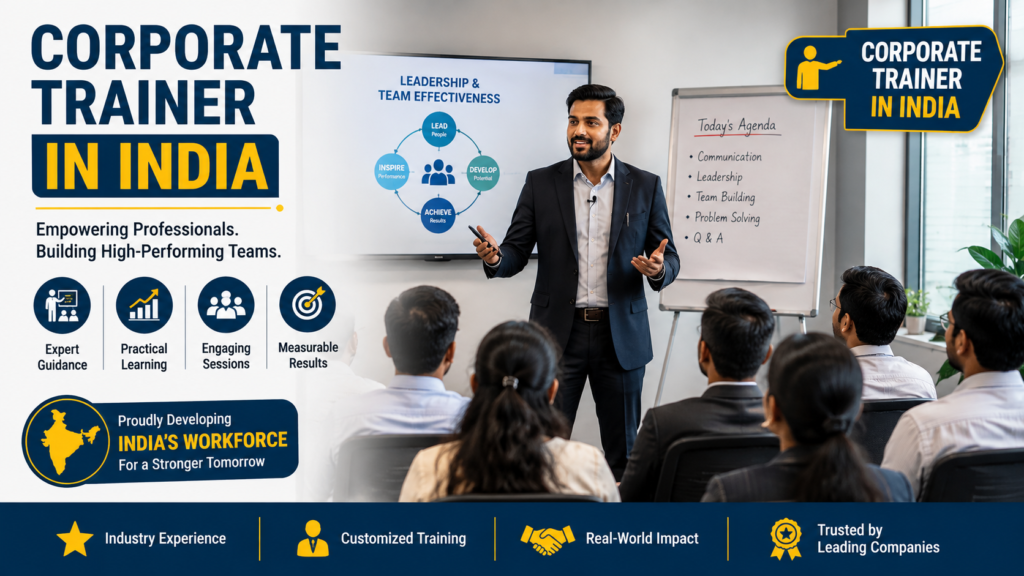
Corporate Trainer in India: Practical Corporate Training Programs for High-Performing Teams
Finding the right corporate trainer in India has become increasingly important for organizations that want to build skilled, adaptable, and high-performing teams. Businesses across India are dealing with rapid technological change, evolving customer expectations, hybrid work environments, leadership challenges, and continuous skill gaps.
Hiring talented employees is only one part of building a successful organization. Companies also need to continuously develop their people through structured corporate training programs that improve workplace skills and support business objectives.
At VSion, corporate training focuses on practical learning, employee development, leadership capability, communication, productivity, and workplace performance. Training programs can be customized according to an organization’s workforce, industry, business goals, and learning requirements.
What Is a Corporate Trainer?
A corporate trainer is a professional who helps employees and organizations develop the knowledge, skills, behaviors, and capabilities required to perform effectively in the workplace.
A corporate trainer may work with employees at different levels, including:
- New employees
- Team members
- Team leaders
- Managers
- Senior executives
- Sales professionals
- Customer service teams
- HR and learning and development teams
Unlike classroom-based education, corporate training is generally focused on workplace application. A good corporate trainer connects learning with real business situations so participants can use new skills in their day-to-day responsibilities.
Depending on organizational requirements, corporate trainers may conduct leadership workshops, communication training, soft skills programs, sales training, productivity sessions, team-building activities, and technology-focused learning programs.
Why Corporate Training in India Is Important
Indian businesses operate in a highly competitive and rapidly changing environment. Employees are expected to learn new technologies, collaborate across teams, communicate effectively, solve problems, and adapt to changing customer and business requirements.
This makes employee development an ongoing business priority.
Organizations may turn to corporate training to address challenges such as:
- Employee skill gaps
- Leadership capability gaps
- Poor workplace communication
- Low team collaboration
- Employee engagement challenges
- Productivity issues
- Sales performance gaps
- Customer service challenges
- Digital transformation
- Changing workplace expectations
- Development of future managers and leaders
The objective is not simply to conduct a training session. Effective corporate training should help employees apply what they learn and contribute more effectively to organizational goals.
Corporate Training Programs Offered by VSion
Corporate training requirements differ from one organization to another. A technology company may need digital skills and leadership development, while a sales organization may prioritize negotiation, communication, and customer engagement.
VSion can structure corporate training programs around specific organizational requirements.
1. Leadership Training
Effective managers and leaders influence employee engagement, team performance, decision-making, and organizational culture.
Leadership training can help managers and emerging leaders develop skills in:
- Decision-making
- Delegation
- Team management
- Conflict resolution
- Strategic thinking
- Coaching and mentoring
- Employee motivation
- Performance management
- Change management
- Workplace communication
Leadership development is particularly useful for organizations preparing high-performing employees for managerial and leadership responsibilities.
2. Soft Skills Training
Technical knowledge is important, but workplace success also depends on communication and interpersonal skills.
Corporate soft skills training can cover:
- Business communication
- Interpersonal skills
- Emotional intelligence
- Team collaboration
- Presentation skills
- Problem-solving
- Critical thinking
- Workplace etiquette
- Professional behavior
- Negotiation skills
These capabilities can help employees communicate more clearly, collaborate effectively, and handle workplace situations with greater confidence.
3. Communication Skills Training
Communication problems can affect teamwork, customer relationships, productivity, and leadership effectiveness.
A corporate communication training program can help employees improve:
- Verbal communication
- Written communication
- Business conversations
- Presentation skills
- Active listening
- Professional email communication
- Workplace discussions
- Meeting communication
- Stakeholder communication
The training can be adapted for employees, managers, sales teams, customer-facing professionals, and leadership teams.
4. Sales Training
Sales professionals need to continuously improve their ability to understand customers, communicate value, negotiate effectively, and build long-term relationships.
Corporate sales training may focus on:
- Prospecting
- Customer engagement
- Consultative selling
- Negotiation
- Objection handling
- Sales communication
- Relationship management
- Closing techniques
- Customer retention
Practical exercises and real-world sales scenarios can help participants connect training concepts with their actual sales responsibilities.
5. Customer Service Training
Customer expectations are continuously changing. Employees who interact with customers need the communication and problem-solving skills required to deliver consistent service.
Customer service training may include:
- Customer communication
- Active listening
- Complaint handling
- Conflict management
- Problem-solving
- Customer experience
- Professional communication
- Service recovery
Well-trained customer-facing employees can respond to challenging situations more confidently and professionally.
6. Time Management and Productivity Training
Poor prioritization can result in missed deadlines, unnecessary work, and reduced productivity.
Productivity training can help employees learn how to:
- Prioritize important tasks
- Manage deadlines
- Organize workloads
- Reduce workplace distractions
- Plan daily activities
- Improve focus
- Manage meetings effectively
- Use productivity tools
The goal is to help employees work more efficiently without simply increasing their workload.
7. Team Building Training
High-performing teams require more than individual talent. Employees must understand how to communicate, collaborate, resolve disagreements, and work toward shared objectives.
Team-building programs can address:
- Collaboration
- Trust
- Communication
- Team problem-solving
- Conflict management
- Role clarity
- Accountability
- Team leadership
Interactive activities, discussions, simulations, and workplace scenarios can make team-building sessions more practical and engaging.
8. Digital and Technology Training
Technology continues to change how employees work. Organizations therefore need employees who can confidently adopt new digital tools and processes.
Corporate technology training can support:
- Digital workplace skills
- Productivity applications
- Data-related skills
- Collaboration tools
- Digital communication
- Technology adoption
- AI awareness and workplace applications
Training can be customized according to the organization’s technology environment and employee skill levels.
What Makes an Effective Corporate Trainer in India?
Choosing a corporate trainer should involve more than looking at the number of training topics offered.
An effective corporate trainer should understand the organization’s business context and create learning experiences that participants can apply at work.
Industry Understanding
A trainer should understand workplace realities and connect training concepts with practical business situations.
Strong Facilitation Skills
Corporate participants learn differently from traditional classroom students. Effective facilitation encourages participation, discussion, reflection, and practical application.
Customization
Training should be adapted according to the organization’s objectives, employee experience levels, industry, and business challenges.
Practical Learning
Case studies, role-plays, simulations, group activities, workplace examples, and problem-solving exercises can make learning more relevant.
Measurable Outcomes
Organizations should have a way to evaluate whether training has improved knowledge, skills, behaviors, or workplace performance.
How VSion Approaches Corporate Training
At VSion, corporate training is structured around the organization’s actual requirements rather than delivering the same generic workshop to every team.
The process can begin with understanding:
- Business objectives
- Employee roles
- Existing skill levels
- Performance challenges
- Learning requirements
- Team structure
- Industry context
- Desired training outcomes
Based on these requirements, training content and activities can be developed to create a more relevant learning experience.
Customized Training Content
Organizations have different workforce requirements. Training content can therefore be adapted to specific teams, roles, industries, and learning objectives.
Interactive Training Sessions
Instead of relying only on presentations, sessions can incorporate discussions, activities, case studies, role-plays, simulations, and practical workplace examples.
Flexible Training Delivery
Corporate training can be delivered through different formats depending on organizational requirements:
- Onsite corporate training
- Online instructor-led training
- Virtual workshops
- Hybrid training programs
- Customized group sessions
Practical Business Focus
The objective is to connect learning with workplace application so employees understand how to use new skills in real situations.
Benefits of Corporate Training for Organizations
A well-designed employee training program can support both individual development and organizational performance.
Improved Employee Performance
Employees can perform their responsibilities more effectively when they have the right knowledge, skills, and confidence.
Better Communication
Communication training can improve collaboration between employees, managers, customers, and other stakeholders.
Stronger Leadership Pipeline
Leadership development can help organizations prepare employees for future managerial and leadership responsibilities.
Improved Team Collaboration
Team-building and interpersonal skills training can help employees collaborate more effectively.
Higher Workplace Productivity
Employees with better planning, prioritization, communication, and problem-solving skills can work more efficiently.
Greater Adaptability
Continuous learning helps employees respond more effectively to changing technologies, processes, markets, and workplace expectations.
Employee Development and Retention
Organizations that provide meaningful development opportunities can create a stronger learning culture and support employee career growth.
Corporate Training for Different Industries in India
Corporate training requirements vary considerably between industries.
A customized corporate training approach can be useful for organizations operating in areas such as:
- Information technology
- Banking and financial services
- Healthcare
- Manufacturing
- Retail
- Education
- Hospitality
- Logistics
- Consulting
- Professional services
- Startups and small businesses
For example, an IT organization may prioritize leadership, communication, collaboration, and digital skills, while a sales-driven organization may require negotiation, customer engagement, and sales performance training.
Corporate Training for Startups and Growing Businesses
Corporate training is not limited to large enterprises.
Startups and growing businesses can also benefit from structured employee development.
As a company grows, employees may move into new responsibilities quickly. New managers may need leadership skills, employees may need better communication capabilities, and teams may need stronger collaboration processes.
Training can therefore support growing organizations as they build scalable teams and develop future leaders.
Corporate Training in the Hybrid Workplace
Hybrid and remote working have changed how employees communicate and collaborate.
Modern workplace training increasingly needs to address areas such as:
- Virtual communication
- Remote leadership
- Digital collaboration
- Online meetings
- Employee engagement
- Accountability
- Remote team management
- Workplace productivity
Managers also need to learn how to lead employees effectively when teams are distributed across different locations.
How to Choose a Corporate Training Company in India
Organizations searching for a corporate training company in India should evaluate more than the training provider’s course catalogue.
Consider the following factors before selecting a training partner:
1. Training Expertise
Check whether the provider has relevant experience in the subjects your organization needs.
2. Customization
Ask whether the program can be adapted to your employees, industry, job roles, and business objectives.
3. Training Methodology
Understand how the sessions are delivered and whether they include practical activities, discussions, case studies, simulations, and assessments.
4. Trainer Experience
Consider the trainer’s professional background, facilitation experience, and ability to work with corporate audiences.
5. Delivery Options
If your workforce is distributed across locations, check whether the provider can support onsite, online, or hybrid delivery.
6. Evaluation
Ask how training effectiveness will be evaluated after the program.
7. Long-Term Learning
For important capability-building initiatives, consider whether the provider can support follow-up learning, reinforcement, assessments, or additional development sessions.
Corporate Trainer in India vs. One-Time Workshop
A one-time workshop can create awareness, but long-term capability development usually requires a broader learning strategy.
Organizations looking for sustainable improvement can combine:
- Skill assessment
- Training workshops
- Practical activities
- Workplace application
- Feedback
- Follow-up learning
- Performance evaluation
This approach can help turn training from an isolated event into a continuous employee development process.
Measuring the Effectiveness of Corporate Training
Training should not end when the workshop finishes.
Organizations can evaluate training effectiveness using indicators such as:
- Participant feedback
- Knowledge assessments
- Skill assessments
- Manager observations
- Behavioral changes
- Employee performance
- Productivity indicators
- Sales performance
- Customer satisfaction
- Achievement of business objectives
The appropriate measurement method depends on the training objective.
For example, communication training may be evaluated through behavioral observations and manager feedback, while sales training may be connected with relevant sales performance indicators.
Why Continuous Employee Learning Matters
Business requirements change continuously. Employees therefore need opportunities to update their skills instead of relying only on the knowledge they acquired when they joined an organization.
Continuous learning can help organizations:
- Develop future leaders
- Improve workforce agility
- Respond to technology changes
- Strengthen employee capabilities
- Encourage innovation
- Improve internal mobility
- Maintain workplace competitiveness
For organizations operating in fast-changing industries, employee development should be treated as an ongoing business process.
Why Choose VSion for Corporate Training?
VSion focuses on creating practical and customized corporate learning experiences for organizations that want to strengthen employee capabilities.
Key areas of the VSion approach include:
Customized Programs: Training can be aligned with specific organizational requirements and employee roles.
Practical Learning: Sessions can use workplace scenarios, activities, discussions, case studies, and interactive exercises.
Flexible Delivery: Organizations can choose suitable onsite, online, or hybrid formats.
Business-Relevant Training: Learning objectives can be connected with workplace responsibilities and organizational goals.
Employee Development: Programs can support individual skill development as well as broader team and leadership capability.
Frequently Asked Questions About Corporate Trainers in India
What does a corporate trainer do?
A corporate trainer helps employees develop workplace skills through structured training programs. Depending on organizational requirements, this can include leadership, communication, soft skills, sales, customer service, productivity, teamwork, and technology training.
Why do companies need corporate training?
Companies use corporate training to address skill gaps, improve employee performance, develop leaders, strengthen communication, improve teamwork, support technology adoption, and prepare employees for changing business requirements.
What are the most common corporate training programs?
Common programs include leadership development, soft skills, communication skills, sales training, customer service, team building, productivity, time management, and digital skills training.
How do I choose a corporate trainer in India?
Look for a trainer or training company with relevant experience, practical training methodology, customization options, flexible delivery formats, and a clear approach to evaluating training outcomes.
Can corporate training be conducted online?
Yes. Corporate training can be delivered through virtual instructor-led sessions, onsite workshops, hybrid programs, or other formats depending on the organization’s requirements.
Is corporate training suitable for small businesses?
Yes. Small businesses and startups can use corporate training to develop employees, strengthen management capabilities, improve communication, and prepare teams for growth.
How can companies measure corporate training effectiveness?
Training effectiveness can be measured through assessments, participant feedback, manager observations, behavioral changes, employee performance, productivity indicators, and relevant business metrics.
Why choose VSion for corporate training?
VSion provides customized and practical corporate training solutions designed around organizational requirements. Programs can focus on employee development, leadership, communication, productivity, teamwork, sales, customer service, and other workplace capabilities.
Build Stronger Teams With the Right Corporate Training Partner
The role of a corporate trainer in India is no longer limited to conducting workshops. Modern corporate training is about helping employees build practical capabilities that support individual performance, team collaboration, leadership development, and business growth.
Organizations that make employee development a continuous priority can create teams that are more capable, adaptable, and prepared for changing workplace demands.
Whether your organization needs leadership training, soft skills training, communication training, sales training, team-building programs, productivity training, or customized employee development, the right training approach can make learning more relevant to your business.
VSion helps organizations design practical corporate training programs that connect employee learning with workplace requirements.
If your organization is looking for a corporate trainer in India, explore a customized training approach based on your team’s skills, business objectives, and future requirements.